Measuring MP reach: how many MPs had the opportunity to see your campaign?
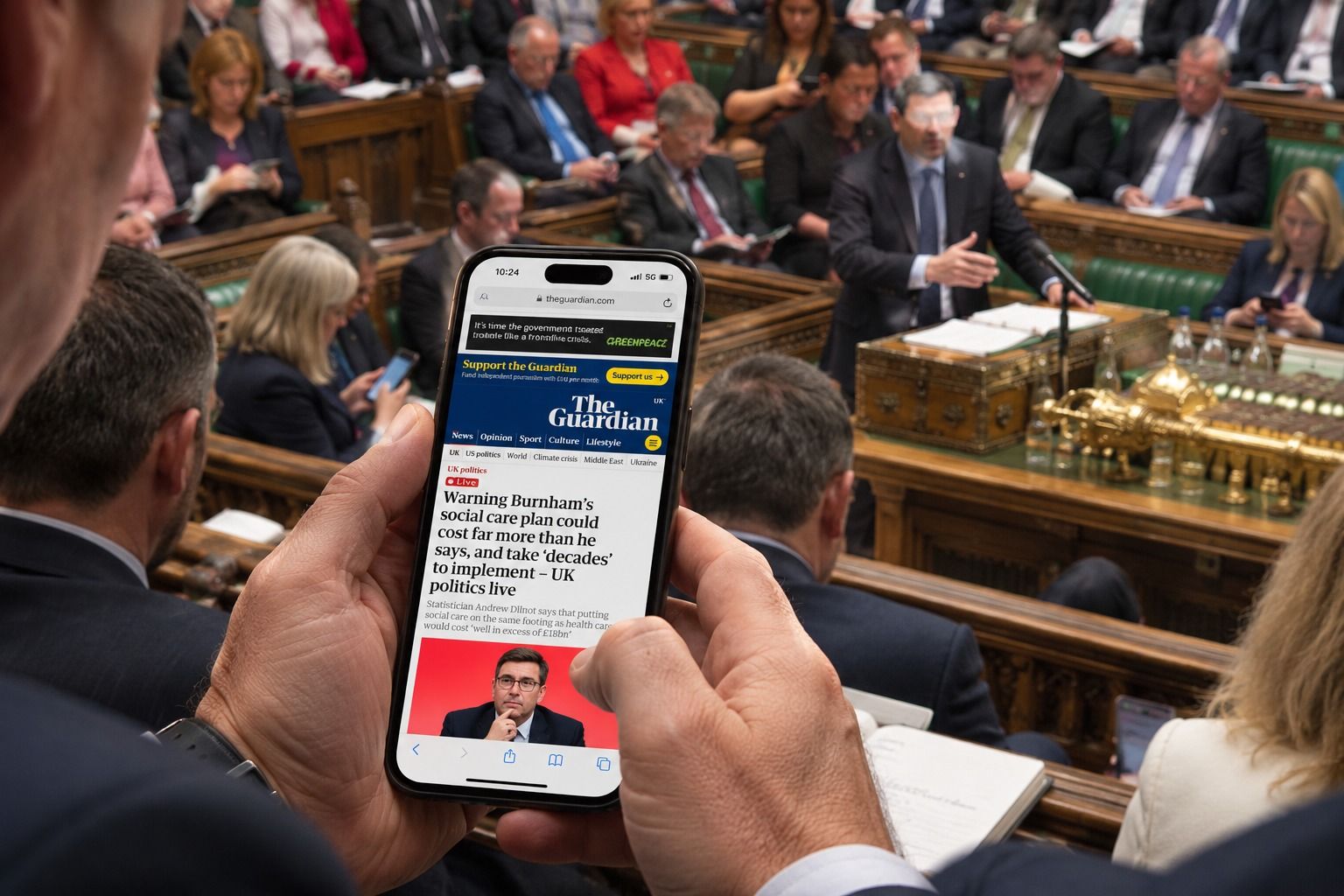
At the end of most public affairs campaigns, someone asks how many MPs saw the advertising. It might be the board, the chief executive or the client. Impressions, click-through rates and engagement figures don't answer it, and tracking individual MPs is neither possible nor appropriate.
We have built a model that gives a reasonable, consistent estimate instead. POTUS by MessageSpace (Parliamentary Opportunity to Understand and See) tells you how many MPs had an opportunity to see a campaign, what share of the House of Commons that represents, and an indicative split by party. This article explains how it works, what it can and can't tell you, and why we think it's a better answer than the alternatives.
Why standard campaign metrics don't answer the question
Digital campaigns report impressions, reach and clicks across the whole audience. A campaign aimed at Westminster might deliver two million impressions, but almost all of them land with people who aren't MPs. That's expected: there are 650 MPs and no platform lets you buy them on their own. It does mean the headline numbers say very little about the audience that matters most.
The gap is often filled with assertions ("every MP reads this title") or targeting claims that can't be checked. Neither holds up when a sceptical finance director asks how the figure was reached.
What MPs read: the research behind the model
MessageSpace runs Influence & Information, an annual survey of MPs' media habits fielded by YouGov. The 2026 edition, published in March, found that:
- 88% of MPs read digital news daily
- 94% use social media daily
- 70% take at least one newsletter
- 77% recall seeing issue advertising in the last six months
The survey also asks which named news sites, political titles, newsletters and podcasts MPs use. That title-level detail is what makes an estimate possible. The sample of 105 MPs is weighted to the make-up of the Commons by party, gender, intake and region.
How POTUS works
POTUS works line by line through the campaign, then combines the results.
- Share of MPs using each channel. From the survey, we take the proportion of MPs who use each title or platform the campaign ran on.
- Likelihood that an MP user was served the ad. This depends on the channel. For a news site, it's our share of the title's page views over the period, applied to how often MPs visit. For a newsletter, it's the open rate across the number of sends. For social media, it's the reach achieved against the size of the audience targeted.
- Combining the channels. Standard media planning duplication formulas combine the lines, with an allowance for overlap between audiences, and the result is applied across the 650 seats in the House. We report a central figure, a range that reflects the survey's margin of error, and an indicative split for Labour and Conservative MPs.
Opportunity to see, not "saw"
The model estimates opportunity to see, the standard measure of reach used across the media industry. It doesn't claim that a particular MP looked at a particular advert, and no individual is tracked. It works on aggregate delivery data and published survey data only, so no personal data is processed.
Keeping the estimate honest
An estimate is only useful if it's consistent. The same fixed assumptions apply to every campaign, whichever publishers carried it: the size of the House, how often MPs visit a site, and the allowance for overlap. Where an assumption could reasonably go either way, we take the more conservative option and report the lower figure.
Titles that don't appear in the survey count as zero. Channels the survey doesn't measure, such as Spotify audio, are listed as delivered but left out of the total. Headline figures are rounded down, and party splits are labelled indicative because the party sub-samples are small.
What the results look like
Each POTUS estimate comes as a one-page summary: the number of MPs, the share of the House, the range, the party split, a breakdown by channel and a short note on method in plain English. It's designed to be shared with senior colleagues or clients without further explanation.
The first two campaigns we ran through POTUS, both multi-channel and around four weeks long, came out at c.230 and c.240 MPs: just over a third of the House in each case.
Planning for MP reach, not just reporting it
The same inputs work in reverse. Knowing which titles MPs use, and how much of each title's traffic a budget can buy, lets us plan a campaign around the number of MPs it is likely to reach, then report against that plan at the end. We now include the POTUS estimate in end-of-campaign reporting for all our public affairs clients, alongside our wider political advertising work.
Frequently asked questions
Is this an exact count of the MPs who saw the campaign?
No. It's an estimate of the MPs who had an opportunity to see it, based on YouGov survey data and standard media planning calculations. The range shows the effect of the survey's margin of error.
Why not track MPs directly?
Tracking identifiable individuals for advertising measurement would raise obvious data protection concerns, and the major platforms don't allow it. The model uses aggregate data only.
How large is the survey sample?
The 2026 Influence & Information survey covers 105 MPs, weighted to the composition of the Commons by party, gender, intake and region. Headline figures use the whole sample; party splits are indicative.
Which channels can be included?
News sites and political titles named in the survey, publisher newsletters, and social platforms including X, Meta and LinkedIn. Named political podcasts can also be included. General audio, such as Spotify, isn't yet covered, and we expect to extend coverage as the research develops.
Can the model be used to plan a campaign?
Yes. The same inputs show which titles and channels are most likely to put a message in front of MPs, and roughly what a given budget should achieve.
To see how POTUS would apply to activity you have planned, contact us on 020 7608 1140 or at hello@messagespace.co.uk.